Quatrohaus Response to TM Pick n Pay
Revised implementation proposal: WhatsApp Commerce Hub for TM Pick n Pay
4 November 2026 | Revised proposal | Confidential
Dear TM Pick n Pay Team,
Yes. The requirements in TM Pick n Pay’s digital-commerce review can be implemented by extending WhatsApp Commerce Hub and integrating it with the TM Pick n Pay online store already developed by Quatrohaus. WhatsApp will provide the shopping and customer-service channel; the existing webstore and its dashboard will provide the central commerce and management experience. We will reuse the existing webstore foundation and extend the Hub’s customer journeys, data contracts, payment services and operational workflows.
This proposal sets out how we will implement the requested capabilities and provides the revised journey, functional matrix, integration design, source-of-record allocation, dashboard mock-ups, permissions, state models, security controls, delivery plan and commercial schedule structure. It distinguishes planned development from current functionality. External loyalty, stored-value, inventory and payment capabilities remain subject to their actual provider interfaces; this does not require rediscovering our own webstore.
How we propose to implement TM Pick n Pay’s requirements in WhatsApp Commerce Hub
We propose extending WhatsApp Commerce Hub in three connected areas: the customer shopping experience in WhatsApp, backend services that enforce commerce and payment rules, and staff tools integrated with TM Pick n Pay’s enterprise systems and existing webstore. The implementation below responds to the executive review. It describes work to be delivered using the current platform foundation; completion must be demonstrated through integration and acceptance testing.
1. Connect enterprise data (review 3.7). Extend the Hub connector layer with adapters for the approved BRM, StorePro, Webstore, Loyalty Platform, Gift Card/Wallet and payment interfaces. Agree which system owns each product, price, promotion, stock, customer, order and payment record. Map external identifiers into Hub records and process updates through background jobs or events, with agreed freshness limits, bounded retries, duplicate detection and reconciliation. Quatrohaus will use its existing webstore codebase and integration knowledge to implement the internal interfaces. External-system adapters will follow the relevant provider contracts.
2. Add product and promotion rules (review 3.2). Extend the product/pricing model with SKU, pack size, variant, unit of measure, sale status, image, store, currency, regular price, promotional price, campaign reference, effective dates and eligibility. The backend will resolve the currently valid price using the authoritative pricing service or agreed rules. WhatsApp search and product details will show the applicable offer; the basket will be revalidated before payment and material changes submitted for customer approval. Test expired, future, overlapping and store-restricted offers.
3. Implement USD and ZiG shopping. Add currency selection and currency-specific price records sourced from TM’s approved price lists. Retain currency consistently across basket, delivery charges, order, payment allocation, refund and reporting; a currency change must reprice and revalidate the basket. Do not assume automatic conversion or mix currencies in a basket. Native Meta catalog publication and display must be validated with the connected account, including acceptance of the required currency code. Showing simultaneous USD and ZiG prices on one native product card is not a confirmed current capability. Agree the supported catalog or WhatsApp Flow presentation before production acceptance.
4. Implement Gift Card/Wallet and split tender (review 3.1). Extend the payment service with a stored-value adapter and a payment-allocation record for each tender component. In WhatsApp, the customer selects the stored-value amount and a supported method for the remainder. The backend checks balance, submits an authorised debit or reservation, verifies the second component and confirms payment only when the verified allocations cover the amount due. Use provider operation references, exact monetary values and duplicate-safe callbacks. Failed second components trigger the agreed reversal or recoverable exception; refunds follow original tender allocations. Enable Zimswitch USD/ZWG only through a provider route confirmed to support them.
5. Implement stock and fulfilment controls (review 3.3). Store the selected fulfilment location in the shopping session and order. Add inventory adapter operations to check availability, reserve with an expiry, commit and release stock. Validate stock before taking payment and block or explicitly handle stale inventory. Add staff picking tasks and substitution proposals; send the proposed item, quantity and new total to the customer for approval through WhatsApp. Only approved changes proceed, with additional authorisation or partial refunds where needed. Pickup readiness and verified handover become recorded events.
6. Add delivery and order exception workflows (review 3.4–3.5). Extend the existing order and courier foundations with delivery-zone validation, fee quotation, allocation, booking and tracking events, proof-of-delivery references and failed-attempt reasons. Implement server-enforced order, payment, reservation, substitution, delivery and refund states. Add WhatsApp tracking and support actions linked to one order/ticket reference. Staff handle amendments, cancellation, returns, redelivery and refunds under agreed cutoffs, permissions and approval rules. Notify customers through permitted WhatsApp messages, using approved templates where required.
7. Integrate operational dashboards and the existing webstore (review 3.6). Extend staff access with branch assignments and role-scoped queues, and synchronise WhatsApp orders and permitted status changes with the existing TM Pick n Pay webstore through its approved interfaces. The operating scope includes 15 branches, each with its own restricted admin dashboard view, and all orders visible in the main webstore dashboard. Use a shared order reference and branch identifier, define the authoritative owner of each status, and recover delayed or duplicate updates without creating duplicate orders. Add national measures, branch/province/product/tender/date filters, exports, repeat-purchase and fulfilment metrics. Report USD and ZiG separately unless an approved reporting conversion policy is configured.
8. Add loyalty registration and identity (review 7). Add Register for Loyalty and Link Real Value Card actions to the WhatsApp journey. Submit approved enrolment fields and programme consent to the Loyalty Platform, handle duplicates and validation failures, and retain the official member reference. Link an existing card only through the programme’s approved ownership-verification process. Retrieve member status and eligible instant rewards at basket or checkout, and record reward reversals when required. Map the member to the enterprise customer identity; a WhatsApp number alone is not verified membership. Stage activation to match programme and API readiness.
9. Implement privacy, security and recovery controls (review 3.8). Record shopping terms, marketing preferences and loyalty enrolment separately. Extend authentication with named users, granular server-side roles, branch isolation and separated refund approvals. Add structured audit events for customer, order, payment, refund, permission and configuration changes, with actor, time, reason and correlation reference. Protect secrets and sensitive identifiers, verify provider callbacks, and implement approved retention and privacy-request handling. Configure monitoring, encrypted backups and restoration drills with agreed recovery targets and support ownership.
10. Deliver through design, build, validation and pilot (review 5). First agree interface contracts, source ownership, policies and acceptance criteria. Produce the integration and transaction diagrams, dashboard mock-ups and role/state models; then implement the data adapters, WhatsApp journeys, payment workflows and operational tools in isolated environments. Validate promotion boundaries, stock concurrency, split-tender failure, late/duplicate callbacks, original-tender refunds, substitution rejection, permissions, webstore synchronisation and restoration. Train staff, reconcile pilot transactions and roll out against agreed acceptance gates. Provide a separately priced schedule for development, integrations, hosting, subscription, Meta messaging, support and third-party charges. The architecture, dashboard mock-ups and delivery controls below form part of this revised proposal. Commercial amounts and calendar dates must be entered by Quatrohaus against the final work estimate; no amounts or deadlines are invented in this document.
1. How WhatsApp Commerce Hub works today
The customer starts a conversation with the business WhatsApp number. The platform processes incoming messages through the WhatsApp integration, maintains the shopping session and guides the customer through consent, Shop, Search Products, View Cart and Support.
Products and categories are imported through the commerce integration. The current WooCommerce connector supplies product information, prices, availability, images and variants. Customers browse or search, select an item, choose the relevant variant and quantity, and review their basket before checkout. Selecting an item in the search Flow does not itself add the item to the basket.
At checkout, the platform records customer and fulfilment details and creates an order. Pickup points and delivery services provide an operational foundation. Payment choices depend on the configured gateway, merchant account and currency. The documented journey includes Visa/Mastercard, EcoCash and InnBucks; availability of each must be confirmed in the merchant's provider configuration.
For card payment, the WhatsApp Flow collects a contact number and hands the customer to the provider's hosted checkout. The current Flow does not collect the card number, expiry or CVV. A submitted contact number is not proof of customer identity. The backend checks the payment provider before treating the order as paid; a customer clicking a payment link or returning to WhatsApp is insufficient.
Merchant dashboard pages provide orders, products, customers, deliveries and integration configuration, with overview charts. The code also includes a Road Runner courier connector for quotation, booking and tracking-related operations. These are reusable foundations; they do not demonstrate an approved national TM Pick n Pay rollout or the full operating model requested in the review.
2. Revised end-to-end customer journey — proposed
1. Welcome and consent: explain shopping terms and privacy information; record the accepted version. Capture marketing permission and campaign preferences separately, with a withdrawal route.
2. Identify the customer: recognise the channel contact. When loyalty is enabled, offer Link Real Value Card or Register for Loyalty using the programme's approved verification process. Shopping without membership depends on TM Pick n Pay policy.
3. Choose fulfilment store: let the customer choose an eligible branch or accept a recommendation based on address, service coverage and availability. Clearly show the selected store.
4. Browse products and promotions: show branch-specific price, pack size, variant, availability and active eligible promotions. Explain loyalty-only conditions where applicable.
5. Review basket: validate prices, promotion eligibility, stock and loyalty benefits against the approved source systems. Request explicit acceptance of material changes.
6. Choose pickup or delivery: show the pickup location or validate the delivery address, service zone, fee and available estimate or slot.
7. Confirm substitutions: capture whether substitutes are allowed and require customer approval for the actual replacement, price change or partial order under the agreed rules.
8. Confirm and reserve: create a traceable order and obtain a time-limited stock reservation before taking payment, where the inventory interface supports it.
9. Pay: offer enabled tenders, including proposed Gift Card/Wallet and split tender. Display currency, total, tender allocation and remaining balance before authorisation.
10. Verify: confirm all required tender components through provider results. Keep uncertain transactions pending for reconciliation; prevent duplicate financial or fulfilment actions.
11. Fulfil and track: send confirmation and progress updates; provide pickup verification or courier tracking as applicable.
12. Resolve exceptions: provide order/support references for cancellation, substitution, failed delivery, return and refund requests, with approval and transaction history.
3. Requirements and proposed resolutions
| Review requirement | Current foundation | Proposed resolution and acceptance evidence |
|---|---|---|
| Consent and privacy | Versioned shopping-terms acceptance exists. | Separate marketing consent, preference history and privacy-request handling. Demonstrate distinct consent records and withdrawal without changing shopping acceptance. |
| Products and promotions | Product, price, stock, image and variant synchronisation. | Add regular/promotional price, campaign ID, effective dates, timezone, branch eligibility, pack size and unit of measure. Test expired, future and restricted promotions and checkout repricing. |
| Additional tenders | Gateway integration and backend verification. | Integrate Gift Card/Wallet and approved Zimswitch USD/ZWG routes. Demonstrate supported currencies, balance checks, split payments, failed components and original-tender refunds in provider test environments. |
| Store stock and reservations | Pickup locations and local stock handling; not enterprise reservation control. | Add branch inventory, freshness checks, reservation identifiers, expiry and release. Test concurrent orders for the last available unit and inventory-service outages. |
| Fulfilment | Orders, pickup points and delivery foundations. | Add picking, substitutions, partial fulfilment, readiness and controlled handover. Demonstrate price/quantity approval and collection verification. |
| Delivery operations | Courier connector and delivery-event records. | Agree coverage, fees, allocation, notification rules, proof of delivery and failure ownership. Test delivered, failed, cancelled and redelivery scenarios. |
| Order exceptions and service | Basic order/payment status and support entry route. | Add controlled amendments, cancellation cutoffs, return/refund approvals and ticket references. Demonstrate full history for an exception case. |
| National reporting | Business dashboard and overview charts. | Add branch/province hierarchy, consolidated measures, tender/currency filters, exports and scoped access. Reconcile pilot reports to source transactions. |
| Enterprise interfaces | Connector architecture with WooCommerce implementation. | Develop approved BRM, StorePro, loyalty, stored-value, Webstore and reporting interfaces. Agree ownership and test data consistency end to end. |
| Security and audit | Authentication, encrypted integration-credential storage and operational logs provide foundations. | Add named staff accounts, granular roles, approval separation, comprehensive audit events, retention and recovery controls. Validate permissions and restoration in acceptance testing. |
| Loyalty and registration | Customer records keyed by business and WhatsApp number; not verified loyalty identity. | Integrate registration, validated Real Value Card linkage, member status, rewards and cross-channel identity. Demonstrate registration, duplicate detection and benefit reversal. |
4. Payments, stored value and financial exceptions
The proposed payment extension would validate the Gift Card/Wallet through the authorised stored-value service, show the usable balance and apply the customer's chosen amount. If that amount is insufficient, a second supported tender would cover the balance. For example, a USD 50 basket could use USD 20 stored value and USD 30 card payment. This example assumes both tenders support USD; mixed-currency tender requires a separately agreed policy.
Each tender leg needs its own amount, currency, provider reference, state and refund allocation. The order is paid only when the verified net allocations equal the amount due. If the second leg fails after stored value is debited, the workflow must reverse the debit or retain it in an explicit recoverable exception under the provider's capabilities and agreed policy. It must not silently charge the customer again.
Unique operation identifiers, duplicate-event handling, controlled retries and reconciliation would prevent repeat debits and repeat fulfilment. A timeout means the outcome is unknown until checked; it must not be treated as proof of failure. Late success after cancellation or reservation expiry should enter an exception queue for controlled recovery or refund.
Refunds would follow original tender allocations, limited to the unrefunded captured amount, with authorised approvals and provider verification. Currency support, Zimswitch routing, provider settlement, reversal capabilities and transaction charges require confirmation from TM Pick n Pay and the payment providers. Monetary calculations in the extension should use exact decimal or minor-unit values rather than floating-point arithmetic.
5. Product pricing, stores and stock
The proposed product contract includes product/SKU identifiers, name, pack size, variant, unit of measure, image reference, sale status, currency, regular price, promotional price, promotion identifier, effective dates, eligibility and branch stock. The price source must resolve overlapping offers and loyalty rules. The platform must not apply every promotion independently where that would create an unintended combined discount.
Selecting another branch triggers basket revalidation. Expired and future promotions are excluded from current selling prices. Branch-restricted promotions are shown only for eligible fulfilment stores. Checkout records the price and promotion decision used for each line and obtains customer approval if the payable amount changes.
The current post-payment local stock deduction is not equivalent to an atomic branch reservation. The proposed enterprise flow requires the authorised inventory system to validate and reserve available quantities, return a reservation reference and expiry, commit the reservation at the agreed milestone and release it after cancellation or expiry. Synchronisation frequency and maximum acceptable data age must be agreed per interface. Stale or unavailable stock data should suspend affected checkout or enter a clearly approved manual process.
For picking exceptions, staff would propose a substitute, reduced quantity or removed item. The customer receives the resulting amount for approval. Extra charges require authorisation; reductions produce the agreed partial refund. No unapproved higher-price substitution should be dispatched.
6. Pickup, delivery and customer service
A proposed branch work queue would show confirmed orders, pick tasks, shortages, approvals and readiness. Pickup would use an order reference plus a one-time collection code or another approved identity check. Staff would record the handover time and responsible user, with escalation for missing codes or delegated collection.
Delivery would validate the address and service zone, calculate and confirm the fee, allocate an approved partner, and track booking, dispatch and completion. Estimates must identify their source and should not imply a guaranteed time unless a service commitment has been agreed. Proof of delivery and failed-attempt reasons would link to the order.
Proposed responsibility: branch operations owns picking and handover; the courier owns delivery execution and evidence; customer service coordinates complaints and redelivery; finance controls monetary reversals and refunds. These assignments require TM Pick n Pay confirmation, including responsibility for redelivery fees and courier-related loss.
Amendments would be allowed only before the agreed picking/dispatch cutoff and would revalidate stock, price and payment. Later requests follow cancellation or return policy. Every case should have a support reference, owner, reason, timestamps and escalation history linked to the order. Response targets and return eligibility remain business-policy decisions.
7. Proposed architecture and system responsibilities
The following is a logical design, not evidence of completed integrations:
Customer WhatsApp → Meta messaging/Flows → Hub conversation, basket and checkout → approved enterprise connectors → source systems.
Branch/Head Office dashboard → Hub operational services → orders, payment allocations, fulfilment events and audit records → approved reporting feeds.
| Data or process | Proposed authoritative owner | Hub responsibility |
|---|---|---|
| Product master and promotion rules | TM-designated BRM/StorePro or other master; allocation to be confirmed | Consume validated product/price contracts and retain checkout snapshots. |
| Branch stock and reservation | Approved inventory system; BRM/StorePro responsibility to be confirmed | Request availability, reserve, commit/release and reconcile. |
| Member identity and rewards | Loyalty Platform | Register/link through approved APIs; use member reference and verified benefit result. |
| Gift Card/Wallet balances | Stored-value platform | Request authorised debit/reversal; retain transaction references. |
| Payment authorisation and settlement | Gateway/acquirer; finance ledger for accounting | Verify results, allocate tenders, reconcile and initiate approved refunds. |
| Commerce order | Existing TM Pick n Pay webstore order service, proposed central order authority | Create or link the channel order once; retain the webstore order reference and synchronise controlled status changes. |
| Webstore customer/order sharing | Existing Quatrohaus-developed TM Pick n Pay webstore customer and order records; Loyalty Platform owns membership | Link channel contacts to the customer record through approved verification and exchange order updates without duplicates. |
| Delivery execution | Approved courier/dispatch system | Quote/book, consume status updates and expose tracking. |
| Management reporting | Approved reporting platform | Supply governed operational facts and reconciled exports. |
Each interface specification should define authentication, schema/version, identifiers, currency, timezone, freshness, events or batch frequency, timeout, idempotency, retry limits, error queue, reconciliation and owner. No BRM, StorePro, loyalty or stored-value API capability is assumed available until its contract is reviewed.
Proposed key transaction sequence: select branch → validate basket and loyalty → obtain stock reservation → create pending order → authorise tender legs → verify full payment → commit inventory/order in the agreed system → release to picking → fulfil → reconcile. Because these span systems, compensating actions and recovery queues are required when a later step fails.
Separate development, test/UAT and production environments would use isolated credentials, controlled configuration and test data. Monitoring would cover interface freshness, sync failures, payment uncertainty, reservation expiry, queue age and notification failures. Quatrohaus would support Hub services; TM ICT and each provider would own their systems, subject to an agreed escalation matrix.
7.1 Integration architecture
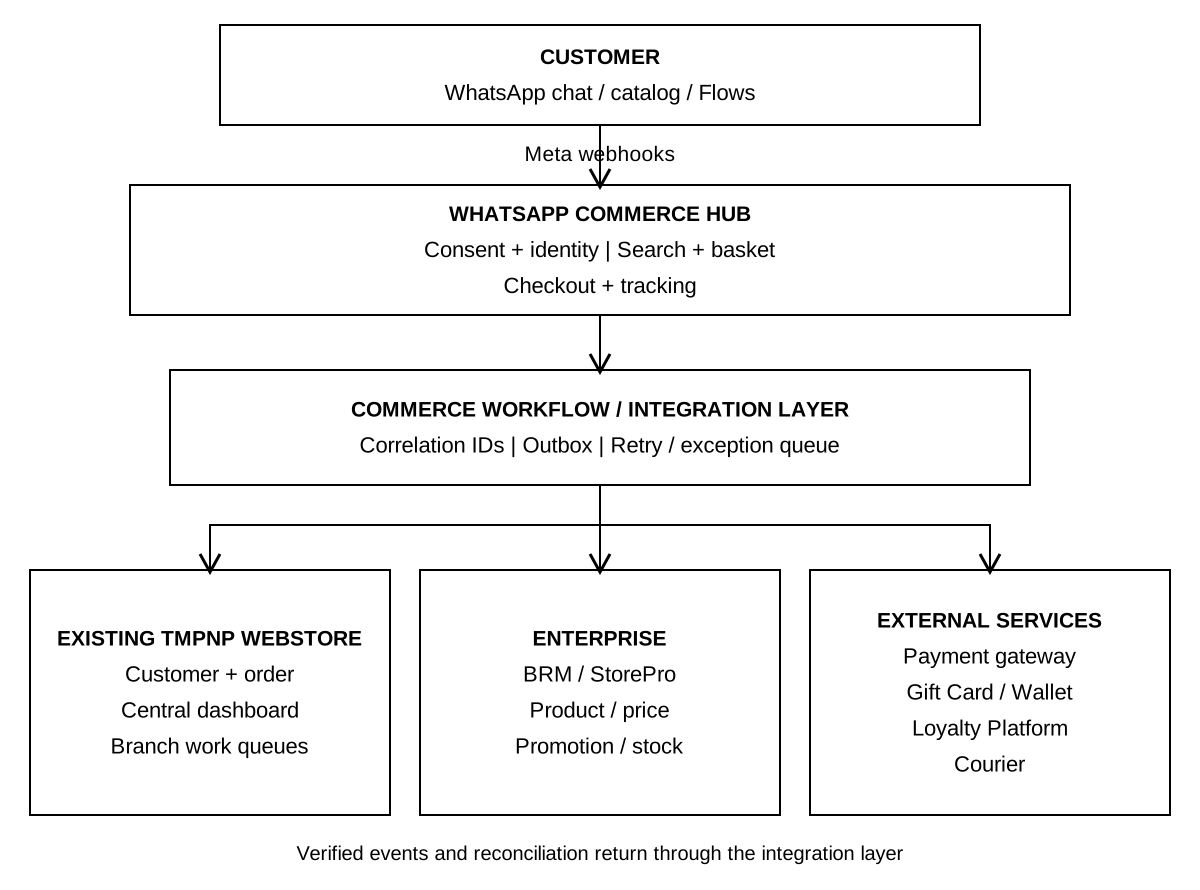
The Hub owns the WhatsApp conversation, consent evidence and channel basket. The proposed webstore order service owns the central commerce order; provider systems own their respective balances, membership and financial outcomes. A local channel record maps to the central order reference. Internal and external writes use a durable outbox and provider-supported duplicate-safe operation keys; uncertain outcomes enter reconciliation before any repeat charge or handover.
7.2 Interface implementation schedule
| Interface | Payload and direction | Trigger and recovery | Implementation owner |
|---|---|---|---|
| Meta to Hub | Message/Flow submissions, contact reference, catalog selections | Authenticate callbacks, deduplicate event IDs, enqueue processing and track failed notifications | Quatrohaus Hub integration |
| Hub to existing webstore | Order reference, branch, customer reference, line snapshots, currency, totals and payment/fulfilment states | Create at confirmed checkout; exchange permitted status events; retry from outbox and reconcile missing/mismatched records | Quatrohaus Hub and webstore services |
| BRM/StorePro to commerce layer | SKU, price lists, promotion windows, branch availability, source timestamp/version | Consume available events or scheduled changes; expose last successful sync; reject checkout data older than the approved limit | Quatrohaus adapter; TM source-system owner |
| Hub to inventory authority | Availability query, reserve, commit, release; reservation ID and expiry | Check at checkout; release on cancellation/expiry; handle paid-after-expiry through revalidation and exception workflow | Quatrohaus adapter; inventory provider |
| Hub to stored-value/gateway | Amount, currency, operation ID, authorisation/debit, reversal/refund and provider reference | Verify callbacks and poll unresolved attempts; reconcile captures/refunds and prevent duplicate tender execution | Quatrohaus payment services; provider |
| Hub to Loyalty Platform | Registration, verified card linkage, member status, reward quote/application/reversal | User enrolment/link action and checkout validation; recover duplicate registration and rejected/expired rewards | Quatrohaus loyalty adapter; programme provider |
| Hub/webstore to courier | Address, zone, quote, booking, tracking and proof-of-delivery reference | Quote before confirmation; verified delivery events update fulfilment; failed bookings enter staff queue | Quatrohaus courier adapter; courier |
| Commerce layer to reporting | Orders, captures, refunds, fulfilment events and customer/member references | Update governed reporting facts after verified events; reconcile totals by currency and source reference | Quatrohaus reporting services |
Exact external endpoint names and supported operations follow provider contracts. Each adapter will define schema version, authentication, timeout, retry limit, dead-letter handling, freshness limit and reconciliation owner. These are implementation specifications, not assumed third-party API capabilities.
7.3 Checkout transaction sequence
| Step | Request and outcome | Failure handling |
|---|---|---|
| 1 | Customer selects store/currency and reviews basket in WhatsApp | Revalidate whenever either selection changes. |
| 2 | Hub validates source prices, active promotions and member rewards | Explain changed totals and obtain customer acceptance. |
| 3 | Inventory service returns reservation reference and expiry | Reject unavailable items or seek approved substitutions; do not take payment on unconfirmed stock. |
| 4 | Hub creates a pending central webstore order with a unique operation reference | Recover by reference before repeating creation; queue failed synchronisation. |
| 5 | Customer authorises stored value and/or remaining tender; Hub verifies each allocation | Unknown outcomes remain pending; failed components use reversal/recovery policy. |
| 6 | Verified full payment triggers stock commit and order confirmation | A commit failure after payment enters a paid exception queue; revalidate or refund with approval. |
| 7 | Webstore/branch staff pick and fulfil; Hub sends customer progress updates | Substitutions require customer approval; delivery failures and returns retain their own states. |
| 8 | Reconcile order, capture/refund, inventory and fulfilment references | Assign and resolve differences without silently overwriting financial evidence. |
8. Dashboard views, measures and permissions — proposed
Head Office view: date and currency selector; branch/province/product/tender filters; paid order count, gross receipts, refunds, net receipts, average basket and payment/fulfilment performance; branch comparison and exception queues. Loyalty participation appears when its integration is active.
Branch view: branch selector restricted to assigned locations; orders awaiting picking, substitutions awaiting approval, ready-for-collection orders, deliveries awaiting dispatch, overdue tasks and order search. An order drawer would show line items, verified tender status, history and permitted actions.
Finance view: payment attempts, captured allocations, refunds, provider settlement references and reconciliation differences, with controlled exports. Administrator view: users, roles, branches, integration health and configuration changes. The proposal mock-ups below show the intended screen structure. Values are placeholders, not operational results; final visual styling will follow the existing webstore dashboard.
| Measure | Proposed definition |
|---|---|
| Paid orders | Distinct orders with verified full payment in the selected period. |
| Gross/net receipts | Verified captures; net receipts subtract verified refunds. Report by currency and show cash-event dates. |
| Average basket | Confirmed paid basket value divided by paid orders, with tax/delivery treatment explicitly agreed. |
| Payment success rate | Successful attempts divided by terminal attempts; pending attempts shown separately. Also show order-level conversion. |
| Fulfilment performance | Paid-to-ready, paid-to-dispatch and on-time completion against agreed targets, by fulfilment type. |
| Repeat purchase | Verified customers with at least two paid orders within the defined observation window. |
| Loyalty participation | Paid orders linked to validated members divided by all paid orders, with reward usage separately reported. |
USD and ZWG totals must remain separate unless an approved exchange-rate source, effective date and conversion rule are configured. Report definitions must distinguish order date, payment date, refund date and settlement date.
| Role | Proposed access and constraints |
|---|---|
| Store picker/supervisor | Assigned branches; pick, propose substitutions, mark readiness and verify handover. No unrestricted refund or credential access. |
| Customer support | Permitted customer/order details, ticket history and exception requests. No unrestricted tender execution. |
| Finance operator/approver | Reconciliation and approved refund functions; requester cannot approve their own controlled refund. |
| Head Office management | Authorised national reports and exports; no implicit rights to modify payments. |
| ICT/integration administrator | Integration health and authorised configuration; secrets masked and access recorded. |
| Security/user administrator | User and role lifecycle; privileged changes audited and periodically reviewed. |
Server-side branch and role checks must apply to APIs and exports, as well as the interface. Exact permissions, approval thresholds and emergency-access arrangements require approval.
8.1 National dashboard mock-up — existing TM Pick n Pay webstore
| TM PICK N PAY — HEAD OFFICE | Screen controls / proposed display |
|---|---|
| Navigation | Overview · Orders · Branches · Payments · Customers · Reports · Exceptions |
| Filter bar | Date range [select] · Currency [USD / ZiG] · Province [all] · Branch [all] · Product [all] · Tender [all] |
| KPI row | Paid orders [—] · Gross receipts [—] · Refunds [—] · Net receipts [—] · Average basket [—] |
| Performance row | Payment success [—] · Pending attempts [—] · Paid-to-ready [—] · On-time fulfilment [—] |
| Charts | Sales over time in selected currency · Branch comparison · Tender breakdown |
| Branch table | Branch / Paid orders / Net receipts / Average basket / Ready overdue / Delivery exceptions |
| Customer panel | Repeat purchase [—] · Validated loyalty participation [—] · Reward usage [—] |
| Exception queue | Order reference / Branch / Payment or fulfilment issue / Age / Assigned owner / Open action |
| Export | Export the filtered, permitted results; record actor, filters and timestamp in audit history |
8.2 Branch dashboard mock-up — restricted operational view
| TM PICK N PAY — BRANCH OPERATIONS | Screen controls / proposed display |
|---|---|
| Header | Assigned branch [name] · Staff user [name] · Date range [select] |
| Queue tabs | Awaiting picking [—] · Approval pending [—] · Ready for collection [—] · Dispatch [—] · Exceptions [—] |
| Filters | Order reference / Payment state / Fulfilment type / Task age / Assigned picker |
| Order list | Order / Customer (masked as appropriate) / Created time / Verified tender state / Total and currency / Task / Owner |
| Order detail | Line items and pack sizes / Price and promotion snapshot / Reservation / Customer approvals / Payment allocations / Event history |
| Permitted actions | Start picking · Propose substitution · Mark ready · Verify collection · Record courier handover · Request escalation |
| Branch measures | Paid orders [—] · Paid-to-ready [—] · Overdue tasks [—] · Failed deliveries [—] |
| Restrictions | No other-branch access; no self-approved refunds; no provider secrets or full sensitive identifiers |
8.3 Dashboard permission matrix
View = permitted within scope; Request = initiate for independent approval; Execute = controlled action; Denied = unavailable. Every permission is enforced by backend APIs and exports as well as navigation.
| Dashboard action | Store staff | Store supervisor | Head Office | Finance operator / approver | Administrator |
|---|---|---|---|---|---|
| View orders | Assigned branch | Assigned branch | National | Financial scope | Support access only if separately granted |
| Pick / mark ready / hand over | Execute in branch | Execute in branch | View | Denied | Denied by default |
| Propose substitution | Request customer approval | Request customer approval | View | View financial impact | Denied by default |
| Cancel / return request | Request | Request under policy | Request | Review financial effects | Denied by default |
| Refund | Request | Request | View | Operator submits; different authorised approver approves | Denied by default |
| National reporting / exports | Denied | Branch only | View / export | Finance view / export | No business-data access by role alone |
| User and role assignment | Denied | Request staff changes | Request access | Denied | Execute authorised changes; audited |
| Integration configuration | Denied | Denied | View health | View reconciliation health | Execute within assigned technical role; secrets masked |
| Audit evidence | Own task history | Branch task history | Permitted business events | Financial events | Security/configuration events within assigned scope |
9. Proposed state model
| Process | Normal path | Exceptions and controls |
|---|---|---|
| Order | Draft → Validating → Awaiting payment → Confirmed → Picking → Ready → Completed | Cancelled, Expired, On hold; payment and fulfilment tracked independently. |
| Payment allocation | Initiated → Pending → Authorised/Captured or verified Success | Failed, Timed out/Unknown, Reversed, Partially refunded, Refunded; supported states depend on provider. |
| Stock reservation | Requested → Reserved → Committed | Rejected, Expired, Released; payment success after expiry requires revalidation. |
| Substitution | Proposed → Customer approval pending → Accepted → Applied | Rejected or approval expired; recalculate and reconcile amounts before handover. |
| Pickup | Awaiting picking → Picking → Ready → Collected | Shortage, customer no-show or cancellation under agreed policy. |
| Delivery | Awaiting booking → Booked → Dispatched → In transit → Delivered | Booking failed, failed attempt, cancelled, redelivery or return to branch. |
| Refund | Requested → Reviewed → Approved → Submitted → Verified | Rejected, provider pending or failed; retain original-tender links and retry safely. |
The extension must enforce permitted transitions on the server, record actor and reason, and prevent duplicate callbacks from repeating stock, payment or delivery actions. A successful payment with failed fulfilment remains a paid exception until resolved; it must not disappear into a generic failure state.
10. Loyalty programme and customer identity
We propose treating loyalty as a separately staged integration aligned with TM Pick n Pay's programme readiness. Customers would be able to register through the platform when the approved registration API and enrolment rules are available. The flow would capture required fields and programme consent, validate them with the Loyalty Platform and return the official membership result. Duplicate or incomplete registrations need explicit recovery.
Existing members would link their physical Real Value Card PAN using an approved identity-verification process. Possession of a WhatsApp number or knowledge of the card number alone must not establish ownership. The loyalty card PAN is a member identifier in this context and must not be confused with a bank payment-card PAN.
The Loyalty Platform would remain authoritative for member status, eligible instant rewards and redemption/reversal rules. The Hub would link the verified member reference to the enterprise customer identity so transaction history can be associated across approved channels. Sensitive identifiers should be masked in staff views, excluded from general logs and stored only as required under the approved protection policy. Shopping terms and marketing consent remain distinct from loyalty enrolment.
10.1 Loyalty customer journey and acceptance
| Customer action | Hub implementation | Acceptance evidence |
|---|---|---|
| Return to WhatsApp | Recognise the channel contact; request approved verification for sensitive identity/link changes | Recognition does not grant another person’s membership or account access. |
| Register for Loyalty | Flow captures approved fields and separate programme consent; backend submits to official enrolment service | Successful, duplicate, incomplete and rejected enrolments return clear recoverable outcomes. |
| Link Real Value Card | Capture PAN securely; verify ownership through the approved identity service; store official member reference and masked display | Invalid or unverified PAN cannot activate benefits; full PAN is absent from staff screens and general logs. |
| Use instant rewards | Retrieve active membership and eligible rewards; apply the authoritative result to the basket and snapshot it on the order | Eligible rewards apply once; expired/rejected rewards reprice with customer acceptance. |
| Shop across channels | Map verified loyalty membership and WhatsApp contact to the existing webstore customer reference | Approved history appears under one customer; unverified matches do not merge identities automatically. |
| Return / cancel | Reverse earned/redeemed benefits under programme rules and reconcile provider references | No duplicate rewards or reversal; unresolved outcomes remain visible. |
| Change marketing preference | Save a separate versioned preference event with withdrawal | Opting out of marketing does not silently revoke shopping acceptance or loyalty identity. |
11. Security, privacy, audit and service continuity
Proposed controls include named staff accounts, least-privilege roles, privileged-user authentication controls, server-side branch isolation, session expiry and separated refund approvals. Encrypted credential storage already provides a foundation; production key custody, rotation and restricted retrieval require an agreed operational design.
An enterprise audit record would capture actor/system, action, entity reference, time, reason, correlation ID and appropriate before/after values for customer, order, payment, refund, permission and configuration activity. Operational message logs alone are not a complete audit trail. Audit storage should restrict alteration and omit secrets, full sensitive identifiers and unnecessary personal data.
Retention periods, deletion/anonymisation, privacy-request verification and access to historical data require an approved policy. Restricted transaction evidence may need different retention from message content. Hosted payment entry should remain with the approved payment provider; the security design must verify webhook authenticity and protect payment references and callback endpoints.
Backups would cover the database and required configuration with encrypted storage, access restrictions and scheduled restoration drills. Recovery point, recovery time, backup frequency and retention are to be agreed before production acceptance. Incident procedures would identify monitoring ownership, escalation contacts, customer-impact communication and recovery steps for Hub, Meta, inventory and provider outages.
11.1 Operational control and recovery implementation
| Control | Implementation and acceptance |
|---|---|
| Identity and permissions | Named staff users, privileged authentication controls, server-side role/branch checks and session expiry; test forbidden actions and cross-branch requests. |
| Payment protection | Hosted provider card entry, callback authentication, duplicate-safe financial operations and masked identifiers; verify duplicate, forged and late callback cases. |
| Consent and privacy | Separate versioned shopping, marketing and loyalty records; verified access/deletion requests with policy-based retention exceptions and logged handling. |
| Audit | Append-oriented access-controlled events with actor, timestamp, action, entity, reason and correlation reference; audit permission/configuration changes and controlled exports. |
| Monitoring | Alert on unavailable services, stale product/stock feeds, failed sync jobs, uncertain payments, reservation expiry and ageing exceptions; route alerts to assigned support owners. |
| Backup | Encrypted database backups and required configuration, restricted credentials and an independently recoverable copy; monitor backup failure and validate restoration. |
| Disaster recovery | Quatrohaus maintains a runbook to restore services, recover secrets/configuration, replay durable events and reconcile provider outcomes before reopening checkout. Agree measurable recovery-point and recovery-time targets against the selected hosting plan before production acceptance. |
| Outage operation | Suspend unsafe payment/stock actions during source outages; preserve pending orders and known transaction references; customer service handles visible exceptions. |
| Incident and support | Record incident severity, owner, impact, escalation, recovery evidence and follow-up actions; provider incidents follow the provider escalation route. |
12. Implementation and validation plan
| Stage | Main outputs and exit condition |
|---|---|
| 1. Confirm scope and dependencies | Approved requirements, policies, owners, API access, data samples, branch model and acceptance criteria. |
| 2. Design and prototype | Integration contracts, final ownership matrix, screen mock-ups, role/state models and commercial scope approved. |
| 3. Configure and build | Isolated environments; source mappings; branch/product setup; required payments, fulfilment, reporting and controls implemented. Loyalty staged according to programme readiness. |
| 4. Integration and acceptance testing | End-to-end provider tests; stock concurrency, promotion boundaries, duplicate/late callbacks, split tender, refunds, substitutions, permissions, performance and restoration verified. |
| 5. Pilot and training | Representative branches trained; operating guides and escalation paths tested; transaction and reporting reconciliation accepted. |
| 6. Controlled rollout and support | Branch rollout gates, monitoring, rollback plan, hypercare and agreed ongoing support activated. |
Initial configuration/migration would map branch IDs, SKUs, price lists, pickup points, delivery zones and approved customer/member references. Data cleansing, deduplication, consent provenance and opening reconciliation must precede live imports. Historical customer data should only be migrated within approved scope.
Pilot evidence should include a promotion expiry, simultaneous last-unit checkout, stored-value plus card payment, second-tender failure, late payment success, partial refund, substitution rejection, failed delivery, blocked unauthorised branch access and successful backup restoration. Rollout timing depends on interface readiness and scope; no fixed delivery dates are committed in this response.
13. Commercial schedule structure
The commercial schedule separates one-time work, recurring services and provider pass-through costs. All amounts are marked “To be costed” because no approved Quatrohaus estimate or tariff sheet has been supplied. This is a structured commercial schedule, not a priced quotation. Existing webstore development will not be presented as new development; only agreed changes and integration work will be costed.
| Cost category | Charging basis | Frequency | Amount |
|---|---|---|---|
| Once-off development | Agreed Hub workflows, existing webstore/dashboard changes and security controls. | One-time | To be costed |
| Integration work | Per enterprise/provider adapter, mappings, testing and reconciliation; avoid duplicate development billing. | One-time | To be costed |
| Hosting and infrastructure | Capacity, environments, database, storage, monitoring, backup and recovery. | Monthly or annual | To be costed |
| Licence/subscription | Platform use, branches, staff access and agreed usage limits; distinguish from hosting. | Monthly or annual | To be costed |
| Meta messaging | Actual applicable messaging charges and separately identified provider handling charges. | Usage-based | To be costed |
| Support and maintenance | Coverage hours, support targets, maintenance allowance and separately priced change work. | Monthly or annual | To be costed |
| Third-party transaction charges | Gateway, bank, stored-value and courier fees under each provider agreement. | Per transaction / delivery | To be costed |
| Optional/future scope | Loyalty activation and other expressly optional work, shown separately from core scope. | Separate work package | To be costed |
Meta rates and provider tariffs have not been independently revalidated for this response. The original indicative messaging estimate should not be treated as a final quotation. Taxes, billing currency, minimum commitments, pass-through costs and exclusions must be explicit in the final commercial schedule.
14. Deliverables supplied and implementation conclusion
| Requested deliverable | Included in this revised proposal |
|---|---|
| Updated customer journey | Section 2: promotions, stored value, split tender, verification, fulfilment and exceptions. |
| Functional requirements matrix | Section 3: requirement, current foundation, proposed implementation and acceptance evidence. |
| Integration architecture and system-of-record matrix | Section 7: architecture diagram, ownership matrix, interface schedule and transaction/failure sequence. |
| Dashboard role/permission matrix | Section 8.3: store, supervisor, Head Office, finance and administrator actions and restrictions. |
| National and branch mock-ups, measures and filters | Sections 8–8.2: screen mock-ups and metric definitions; placeholders identify intended displays. |
| Order/payment/refund/substitution/fulfilment states | Section 9: independent lifecycle models and exception controls. |
| Security, privacy, audit, monitoring, backup and disaster recovery | Section 11: implementation controls and recovery acceptance. |
| Implementation plan | Section 12: environments, configuration/migration, testing, training, deployment and support gates. |
| Commercial schedule | Section 13: separately identified charges and charging basis; amounts await Quatrohaus costing. |
| Future loyalty and customer identity | Sections 10–10.1: registration, verified Real Value Card linkage, rewards, unified identity and separate consent. |
Quatrohaus can implement this solution by extending WhatsApp Commerce Hub and the TM Pick n Pay webstore that we developed. The existing online store is part of our implementation foundation. The work is to connect the WhatsApp customer journey to that foundation, add the requested enterprise workflows and demonstrate the end-to-end behaviour through acceptance tests.
The proposed solution supports the requested commerce and operational model. Specific external payment, stored-value, loyalty and inventory operations depend on those systems’ supported interfaces. Simultaneous USD and ZiG native catalog price display remains a Meta validation item; it is not asserted as an existing capability. Quatrohaus will complete the commercial amounts and delivery dates from the implementation estimate and current provider tariffs. No new general requirements-discovery session or request for TM to supply information about our own webstore is proposed as a prerequisite.
Kind regards,
Quatrohaus Team